



Getting into a top UK university takes a lot more than decent A-level grades. Some universities reject five out of every six people who apply, and the competition gets harder every year. If you are putting together your UCAS list, knowing which institutions are the most selective helps you plan smarter and apply with realistic expectations.
This guide covers acceptance rates, typical grade requirements, admissions tests, and what actually separates a successful application from a rejected one at the UK’s most competitive universities.
What Makes a University Hard to Get Into?
Acceptance rate is the clearest measure of how selective a university is. It shows the percentage of applicants who actually receive an offer. The lower the number, the harder it is to get in. But acceptance rate alone does not tell the full picture.
Many of the hardest universities also require admissions tests, conduct interviews, and look closely at personal statements alongside predicted grades. Getting into top UK universities requires more than just strong grades.
Strong personal statements, solid admissions test scores, and relevant extracurricular achievements all carry real weight in the decision. So even if you hit the grade requirements on paper, you still need to stand out in every other part of your application to have a genuine shot.
The UK national average acceptance rate across all universities sits at around 72%. The universities on this list sit well below that of some dramatically so.
The Hardest UK Universities to Get Into in 2026
1. London School of Economics (LSE)
LSE is currently the hardest UK university to get into, with an acceptance rate of just 7.6%. It is a world leader in economics, politics, law, and social sciences, which means it pulls in thousands of highly qualified applicants every year for a very limited number of places. The competition is brutal at every stage of the process.
For the most competitive courses, you will need A*AA or higher at A-level, plus a personal statement that shows genuine intellectual engagement with your subject rather than a list of achievements. LSE wants students who already think like economists, political scientists, or lawyers, not students who are hoping to learn how to think that way after they arrive.
If you are planning to study in London, check our guide on student accommodation london
2. Imperial College London

Imperial College London has a 10.60 per cent acceptance rate, which reflects its status as a global science and technology leader. From 32,887 applications, only 3,483 students received offers. If STEM is your path, engineering, computing, medicine, or life sciences, Imperial is one of the hardest places to land a spot anywhere in the UK.
Most programmes require A-level Mathematics at grade A or A*, and many courses also require admissions tests like the TMUA. Imperial is exclusively science and technology focused, so there are no arts or humanities routes in through the back door. You either meet the science requirements or you do not get in.
3. University of Oxford
The Oxford acceptance rate is usually around 15%, but this varies by course; some competitive subjects sit far lower. Oxford runs a tutorial system where students work directly with leading academics on a weekly basis, and the interview process is built to test how applicants think through new problems, not how much they have memorised from a textbook.
The October 15 UCAS deadline gives Oxford applicants significantly less time to prepare than applicants to other universities. Planning ahead is not optional. Miss that deadline and your application is over before it began. If Oxford is on your list, start preparing earlier than you think you need to.
4. University of Cambridge
The University of Cambridge accepts fewer than 1 in 12 applicants. Like Oxford, Cambridge uses interviews conducted by college academics, and from 2026, both universities have moved to the UAT-UK framework for admissions testing, with the TMUA, TARA, and ESAT replacing older tests like the MAT and TSA.
Competition is especially fierce in subjects like Medicine, Law, Economics, and Natural Sciences. Strong predicted grades are the starting point, not the finish line. Cambridge also has a collegiate system, which means your choice of college can affect your chances depending on the subject you are applying for, something most applicants do not think about early enough.
5. University College London (UCL)

UCL consistently appears on the list of the hardest universities to get into in the UK, primarily due to its steep rise in applicants across high-demand disciplines like Economics, Medicine, and Law. In 2024, UCL received over 79,000 applications and accepted around 7,000 students an acceptance rate of roughly 8.9%.
UCL is introducing new admissions tests for 2026 entry across engineering, economics, computer science, and other subjects using the TARA framework. Meeting the minimum grade requirements is nowhere near enough at UCL. The volume of high-quality applications means the bar for every part of your submission has to be genuinely strong.
6. University of St Andrews
St Andrews has an acceptance rate of around 25%, which still makes it one of the hardest universities to get into, especially for certain subjects. It is Scotland’s oldest university, known for intimate teaching, academic excellence, and its stunning seaside setting. Entry standards at St Andrews are among the highest in the UK.
Typical offers often fall in the ABB to A*A*A range at A-level, and around 36 to 38 points in the IB, depending on the degree. The university attracts a large number of international applicants, which pushes competition higher than the headline acceptance rate might suggest for certain programmes. If you are coming from outside the UK, checking student accommodation options early is worth doing alongside your application.
7. University of Warwick
Warwick’s acceptance rate has tightened gradually in recent cycles, reflecting a steady rise in applicant numbers. As applications grew to more than 48,000 for 2024 entry, the acceptance rate moved down to 12.6%. Warwick is particularly competitive in business, economics, mathematics, and related subjects, where typical offers regularly reach A*AA, including specific subject requirements.
Warwick is a strong example of how a university’s overall acceptance rate can mask very different realities at the course level. Some departments are genuinely approachable. Others are as competitive as anything Oxford or Cambridge offers in the same subject area.
8. Durham University

Durham operates a collegiate structure similar to Oxford and Cambridge, which gives it a distinct academic character compared to most UK universities. Its tutorial-style teaching promotes academic rigour and close faculty engagement, naturally limiting student intake and positioning it among the UK’s universities with the lowest acceptance rates.
Durham’s current acceptance rate sits at approximately 39%. That is higher than the other universities on this list, but still well below the UK average, and competition is especially strong in Law, Medicine, and Natural Sciences. Durham’s reputation pulls in a high volume of strong applicants, which keeps standards competitive across most subject areas.
9. University of Bristol
Bristol is a strong example of how entry standards can be high even when requirements vary significantly by course. Business and Management lists AAA or AAB, Law often asks for A*AA or A*A*B, and Computer Science typically requires A*AA, including A* in Maths. The hardest offers are concentrated in specific departments, so the course you choose within Bristol matters enormously.
Bristol consistently ranks highly in UK league tables and attracts a large number of applicants from both domestic and international students. Its location in a popular student city adds to its appeal, which in turn keeps application numbers and competition high year after year. Students who secure a place often start looking at university halls vs private halls early to get the best accommodation before spaces fill up.
10. King’s College London (KCL)
KCL sits in the heart of London with strong connections to major hospitals, legal institutions, and government bodies. Entry requirements vary by course, but competitive programmes can be seriously demanding. Business Management lists A*AA at A-level, including a grade A in a Humanities or Social Science subject.
Medicine and Law at KCL are particularly competitive, with applicant numbers that regularly far exceed available places. Being based in London also means KCL competes directly with UCL, LSE, and Imperial for the same pool of highly qualified applicants, which keeps its own standards consistently high.
What Grades Do You Actually Need?
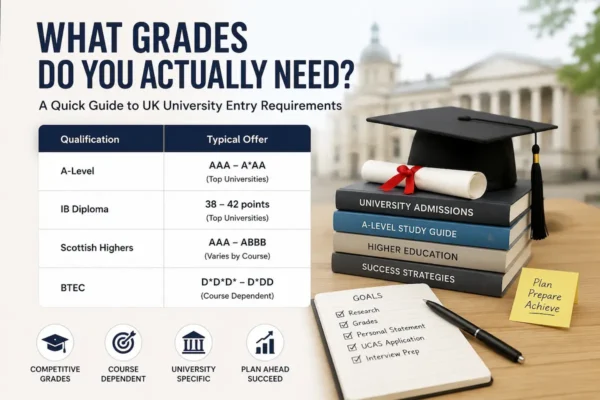
For top universities and courses like Medicine or Economics, expect to need at least A*A*A to A*AA at A-level, in addition to strong applications and personal statements. Some courses sit even higher than that in practice when you look at what admitted students actually arrive with, rather than the minimum stated offer.
It is worth checking individual course pages rather than just the university-level requirements. Grade expectations can vary significantly between departments at the same university, and the course you apply for matters as much as the institution itself. A student applying for Geography at Oxford faces very different competition from one applying for Computer Science at the same university.
Least Employable Degrees in the UK
Picking a hard university to get into is only half the decision. The subject you study matters just as much for what comes after graduation. Using the latest HESA Graduate Outcomes survey, some subjects lead to weaker employment outcomes 15 months after graduation than others.
The UK university degree subject that produces the least money for graduates is media, journalism, and communications. Creative arts and design graduates also face a tough early market, with many piecing together income through freelance or short-term work rather than stable graduate roles. Historical, Philosophical, and Religious Studies sees only 43% of graduates in full-time employment shortly after graduation.
This does not mean these degrees have no value; skills built through humanities and creative subjects translate into many careers over time. But if early financial stability matters to you, it is worth thinking about subject choice alongside university prestige when you are building your application list.
Once you have your university confirmed, finding student accommodation near me should be your next priority before good options fill up.
How to Actually Strengthen Your Application
Getting strong grades is the foundation, but it is rarely enough on its own at these universities. Start your personal statement early and make it specific to your subject — vague enthusiasm does not land well at this level. Prepare seriously for any admissions tests relevant to your course, since these carry real weight in the final decision.
If you are applying to Oxford, Cambridge, or a medicine programme, practice interview techniques regularly. Interviews test how you reason through problems in real time rather than how much you know. Research your chosen course beyond the A-level syllabus and show that engagement clearly in your writing.
Apply on time the October 15 deadline for Oxford and Cambridge is non-negotiable, and late applications are simply not accepted. Work experience and extracurricular activities also help, but only when they are genuinely relevant to your subject rather than just padding out a CV. Admissions tutors at selective universities read thousands of applications and can tell the difference quickly.
FAQs
Which is the hardest UK university to get into?
LSE, with an acceptance rate of just 7.6%, followed closely by Imperial at around 10.6%.
What A-levels do you need for the most selective UK universities?
Most competitive courses require A*AA or A*A*A. Subject requirements also vary by course, so always check individual programme pages.
Is it harder for international students to get into UK universities?
Yes, in many cases. Acceptance rates for international students can be lower at selective universities due to high global demand.
Do hard universities all require admissions tests?
Not all, but many do. Oxford, Cambridge, UCL, and Imperial use tests for certain subjects. Check each course page for current requirements.
Does going to a selective university guarantee a better career?
Not automatically. Your subject, work experience, and skills matter as much as the university name on your CV.

