



Choosing where to live during university is one of the most important decisions you will make as a student. Most students end up comparing two main options. University halls and private student halls. Both give you a place to sleep, study, and build your social life.
But they work very differently in terms of cost, facilities, location, support, and daily experience. This guide covers everything you need to know before booking. Cost breakdowns, room types, safety, social life, bills, international student advice, and a practical checklist. By the end, you will know exactly which option suits your situation.
Quick Answer: University Halls vs Private Halls
University halls are often the better starting point for first-year students. They sit close to campus, come with built-in support teams, and make social life easier from day one. Everyone around you is going through the same experience at the same time. That shared starting point helps friendships form quickly.
Private student halls are managed by private companies rather than universities. They tend to offer more modern rooms, better facilities, and more flexibility in room choice. But they can cost more and may feel less connected to campus life depending on the location.
The right answer depends on your budget, your course location, your personality, and what you want from your living situation. Neither option is better for every student.
What Are University Halls?
University halls are accommodation owned and managed directly by the university. They sit on campus or within easy walking distance of the main university buildings. That makes daily life much simpler, especially in the first few weeks when everything feels new and unfamiliar.
Rooms come furnished with the basics — a single bed, a desk, a wardrobe, and some storage. Most halls have shared kitchens on each floor, communal bathrooms or basic ensuites, laundry rooms, and common areas where students can meet and socialise. The biggest advantage of university halls is the support structure.
Most halls have resident assistants, also called RAs or wardens, who live in the building. These are older students or trained staff who help residents settle in, sort problems, and access university welfare services when needed. University accommodation offices usually put first-year and international students first for hall places.
These groups benefit most from having support close by during the move into university life. Spaces fill up fast, so apply early — ideally at the same time as your UCAS application. Late applicants sometimes miss out and have to look at private student accommodation options instead. For official guidance, check UCAS accommodation advice.
What Are Private Halls?
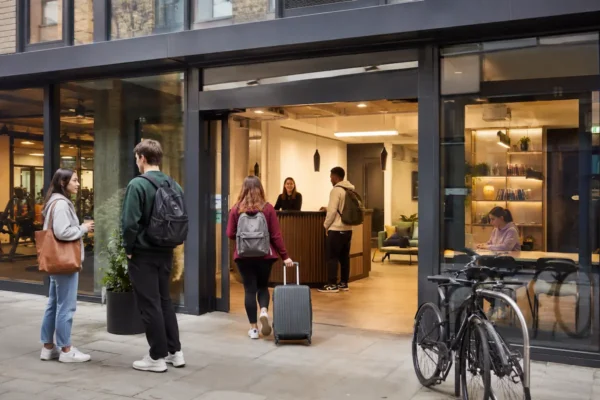
Private student halls are owned and managed by private companies, not universities. Major UK operators include iQ Student Accommodation, Scape, Canvas, Host, Vita Student, True Student, and Unite Students. These companies build purpose-built student accommodation across most major UK cities, and the buildings often feel much more like modern apartments than traditional university halls.
Room options are usually much wider in private halls. You can choose between a standard room with shared bathroom, an ensuite with a private bathroom, a cluster flat with a shared kitchen, or a fully self-contained studio with your own bedroom, kitchen, and bathroom. That range suits different budgets and privacy needs.
Most private halls come with strong on-site facilities. Gyms, cinema rooms, study spaces, rooftop terraces, social lounges, bike storage, and 24-hour reception are common in newer buildings. Bills are usually included in the weekly rent — WiFi, heating, electricity, and water all covered in one fixed payment. No separate accounts, no surprise invoices.
Private halls often sit in city centres or near major transport links rather than directly on campus. That works well if you want city access, but commuting to lectures is something worth checking before you book. Always confirm the real travel time from the building to your main university buildings before signing anything related to private student accommodation.
University Halls vs Private Halls: Quick Comparison
| Feature | University Halls | Private Halls |
|---|---|---|
| Best For | First-year, freshers | Any year, independent students |
| Cost Control | Often more predictable | Can be higher depending on room |
| Location | On or near campus | City centre or transport links |
| Privacy | Shared or basic ensuite | Wide range including studios |
| Room Types | Standard, shared, ensuite | Ensuite, studio, cluster flat |
| Bills | Sometimes included, check carefully | Usually all-inclusive |
| Facilities | Basic to moderate | Often modern and well-equipped |
| Social Life | Strong fresher community | Depends on building and management |
| Support | University welfare teams on site | Private reception and security |
| Booking Process | Through university portal | Direct with the provider |
| Contract Flexibility | Usually fixed academic year | Varies by provider |
| Guarantor Rules | Depends on university | Often required or pay upfront |
Cost Difference Between University Halls and Private Halls
Cost is usually the first thing students and parents look at when comparing options. University halls can be easier to budget because the pricing structure tends to be simpler. Some universities bundle basic utilities into the hall fee, while others charge separately or include a usage cap. Always read exactly what the quoted price covers before making any assumptions.
Private halls often cost more per week because of modern buildings, ensuite or studio rooms, and included facilities. However, the comparison is not always straightforward. A university hall that excludes bills could end up costing more in total than a private hall that includes everything. Always calculate the full cost over the entire contract length, not just the weekly rate.
Costs vary by city, university, room type, and contract length. A shared room in a northern city university hall will cost very differently from a studio in a private hall in central London. Never assume university halls are automatically cheaper — sometimes they are, sometimes they are not.
Location and Travel
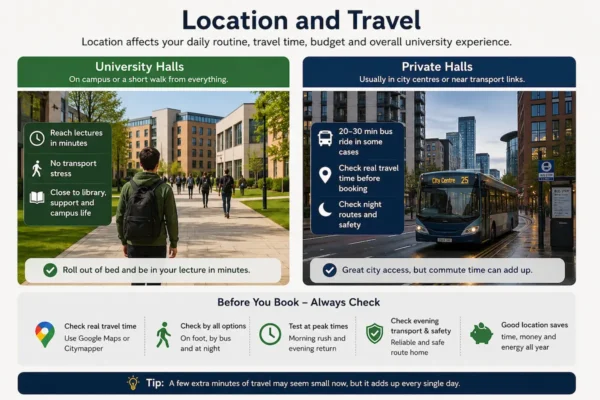
Location is one of the most underestimated factors when choosing student accommodation. University halls sit on campus or a short walk from lectures, the library, and student support. You can roll out of bed and reach your lecture in minutes without any transport stress.
Private halls are often in city centres or near transport links. Some sit close to campus, but others require a 20 to 30 minute bus ride. That feels fine in September but very different on a cold February morning at 8am. Before booking, check the real travel time using Google Maps or Citymapper — on foot, by bus, and at night.
Also check evening transport. If lectures or social life keep you out late, a reliable route home matters a lot. Some areas feel safe in daylight but very different at 11pm. A good location saves time, money, and energy across a full academic year.
Privacy and Room Types
How much privacy you get depends on the room type you choose and what is available in your preferred halls. University halls have historically offered standard single rooms with shared bathroom facilities, though many universities have upgraded their buildings and now offer ensuite rooms too.
Private halls offer a much wider range. Standard rooms with shared bathrooms are the most affordable. Ensuite rooms give you a private bathroom attached to your bedroom. Cluster flats group you with a small number of students where you each have your own bedroom and bathroom but share a kitchen. Studios are fully self-contained with your own bedroom, bathroom, and kitchen.
If privacy matters to you for studying or recharging, private halls give you more options to suit your budget. If you do not mind sharing facilities and want to keep costs low, a standard university hall room works perfectly well for a full academic year.
Bills and What Is Included
Understanding exactly what is included in your rent is one of the most important steps before signing any accommodation contract. In university halls, the situation varies. Some universities include heating, electricity, water, and WiFi in the hall fee.
Others include some utilities but charge separately for others. A few older halls charge for electricity usage through a meter top-up system. Always ask the accommodation office exactly what is and is not included before you agree to anything.
In most private halls, the rent is advertised as all-inclusive. That typically means WiFi, heating, electricity, water, contents insurance, and sometimes laundry credits are all covered in your weekly payment.
This makes budgeting very simple because you know exactly what you will pay every week with no surprises. However, some all-inclusive private halls have a fair usage policy on utilities. If you use significantly more than the average resident, you may be charged extra. Check the contract for any fair usage caps or additional charges before signing.
Also, check the deposit arrangements before booking. In the UK, deposits must be held in a government-approved tenancy deposit protection scheme. Ask which scheme is being used, how much the deposit is, and when you will get it back at the end of the contract.
Some halls require a UK-based guarantor. If you are an international student or do not have a UK guarantor available, many providers will accept a larger advance rent payment instead. Confirm this before applying.
Facilities and Social Life

University halls typically offer shared kitchens, laundry rooms, common rooms, and some study spaces. Larger universities may also have on-site dining halls or cafes. Social events are often organised by resident assistants or the student union, especially during freshers week.
Private halls offer more in terms of modern facilities. Most newer buildings include gyms, cinema rooms, study spaces, rooftop terraces, social lounges, and 24-hour reception. Some premium providers also run regular social events and wellbeing sessions throughout the year.
Social life in university halls feels more immediate for first-year students because everyone is from the same institution and going through the same experience. Friendships form quickly in shared kitchens and common rooms.
In private halls, residents come from different universities, which can broaden your social circle in interesting ways. Neither option guarantees a great social life — it depends on the building, the management, and how much effort you put in.
Safety and Student Support
University halls have strong safety measures in place. Secure entry systems, CCTV, and key fob access are standard. Resident assistants live in the building and help students deal with problems and access support. University welfare teams and counselling services are closely linked to hall management and easy to reach.
Private halls also invest heavily in safety. Most modern buildings have 24-hour staffed reception, secure electronic entry, and CCTV in communal areas. Some providers have dedicated wellbeing coordinators who direct residents to the right support services.
The main difference is connection. University halls link directly to the full range of university welfare, disability, and academic support services. In private halls, accessing personal or academic support may need more independent effort since the management team sits outside the university.
Most good private providers still train staff to handle welfare concerns and point residents in the right direction. Always check the security setup, maintenance process, and welfare support available before committing to any accommodation.
Which Is Better for First-Year Students?
University halls are often the easier and more comfortable starting point for students in their first year. You are close to campus. Support is accessible. Social events happen naturally because the building is full of people going through the same experience at the same time.
That shared starting point makes it much easier to meet people and build friendships quickly, which matters a lot in those first uncertain weeks. The structure of university halls also helps students who find new environments challenging.
Knowing there is a resident assistant on your floor, a welfare team in the building, and the campus just outside the door can make the transition into independent life feel far less overwhelming. Private halls can still work very well for first-year students.
If university accommodation is full, too expensive, or simply not available in your preferred location, private halls are a solid alternative. Some first-year students actively prefer private halls because of the more modern rooms, better facilities, and the independence that comes with living in a city-centre building.
The key question is what you personally need from your accommodation in that first year. If you thrive with structure and close support, university halls will serve you well. If you are confident, independent, and want a more modern setup, private halls may suit you just as well.
Which Is Better for International Students?
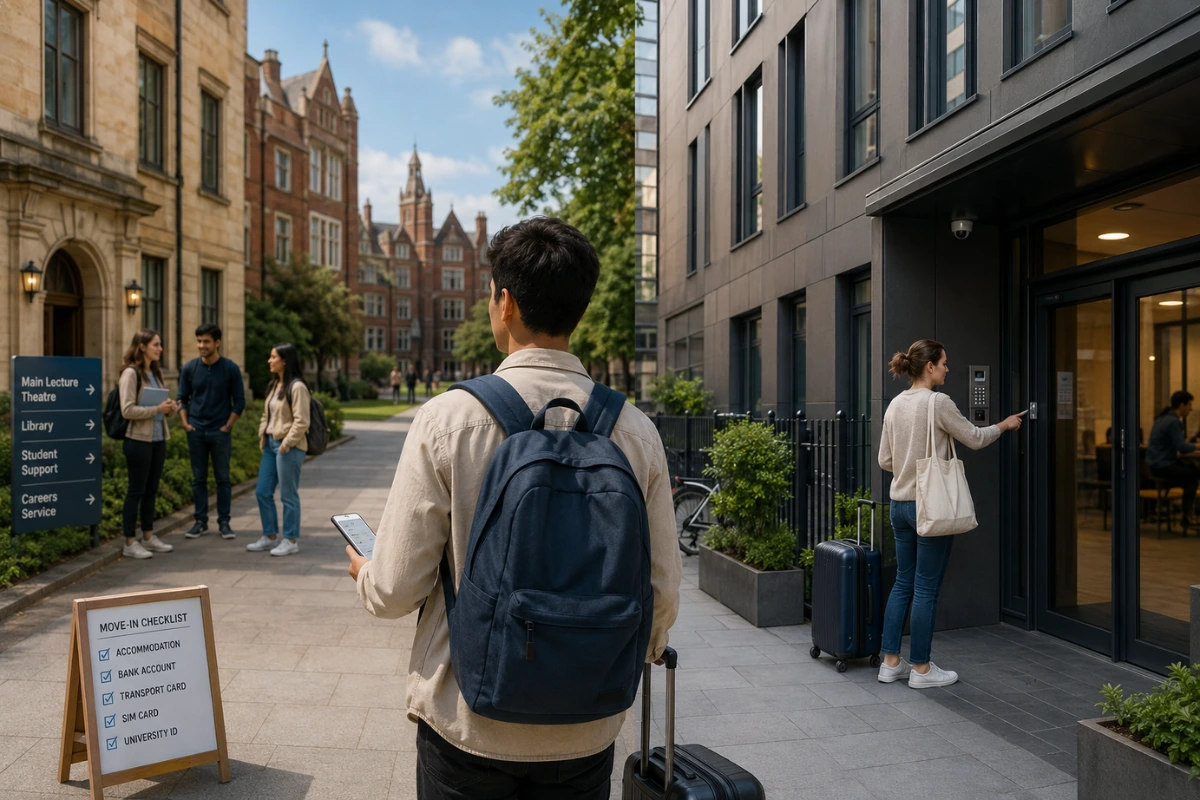
International students often have additional things to consider when choosing between university halls and private student halls. University halls can feel more reassuring for students arriving in the UK for the first time. Support is on site. Campus is close.
Help is easier to access during those crucial first weeks when everything is new and potentially confusing. Many universities also offer dedicated international student support services that work closely with the accommodation teams in halls.
Private halls are also a strong option for international students. Many private providers have significant experience supporting students arriving from overseas.
Arrival packs with basic essentials, flexible check-in dates, international-friendly booking processes, and advance rent payment options instead of UK guarantors are all things worth checking when comparing providers.
Before booking either option, international students should check and confirm the following. When exactly can you move in, and does that date align with your arrival in the UK? What is the contract length, and is it flexible if your plans change? Is a UK guarantor required, or can you pay a block of rent in advance instead?
What is included in the rent, and are there any charges you might not expect? How far is the accommodation from campus, and what is the transport route like? Also check the cancellation policy carefully. If your visa application is delayed or refused, you need to know what your options are before you sign any legally binding agreement.
Pros and Cons of University Halls
Pros:
- Located on or very close to campus
- Built-in support from resident assistants and welfare teams
- Strong social community, especially for first-year students
- Simple booking process through the university accommodation portal
- Closely connected to student union events and campus life
- Often prioritised for first-year and international students
Cons:
- Limited room type options in many buildings
- Older buildings may lack modern facilities like gyms or study rooms
- Bills are not always included and vary between universities
- Spaces fill up quickly and cannot always be guaranteed
- Less flexibility in contract length or room type choices
- Can feel more institutional compared to modern private alternatives
Pros and Cons of Private Halls
Pros:
- Wide range of room types including ensuites, cluster flats, and studios
- Modern buildings with gyms, study spaces, cinema rooms, and social areas
- Bills usually included in a single weekly payment
- 24-hour reception and strong security in most buildings
- Open to students from any university in the city
- Often well-located near city centres and transport links
Cons:
- Weekly cost can be higher than standard university halls
- May be further from campus than university-managed accommodation
- Social community depends on the specific building and management
- Less directly connected to university welfare and academic support services
- Contract terms and cancellation policies vary significantly between providers
- Guarantor requirements or advance rent payments may be needed
What to Check Before Booking Student Halls

Do not rush into any booking without going through this checklist carefully.
- Total weekly rent and exactly what it covers
- Full contract length and the exact start date
- Which bills are included and whether any have usage caps
- Deposit amount and which protection scheme holds it
- Cancellation policy and what conditions apply
- Whether a UK guarantor is required or an advance payment alternative exists
- Room type and what furniture and appliances are in the room
- Actual distance and travel time from your main campus
- Transport links and evening route options
- Security setup including entry systems, CCTV, and reception hours
- Recent reviews from students who have actually lived in the building
- Maintenance reporting process and typical response times
- Laundry facilities and whether there is an extra cost
- WiFi speed, reliability, and whether it is truly unlimited
- Guest and visitor rules and any overnight policy
If you are booking from overseas, always ask for a live video viewing of the actual room, kitchen, bathroom, entrance, and outside street. Edited listing photos tell you very little about what daily life in a building actually feels like.
Final Verdict: University Halls vs Private Halls
There is no single winner when comparing private student halls and university halls. University halls work best for students who want campus proximity, structured support, and a natural social start to their university experience.
They are especially well-suited to first-year students and international students arriving in the UK for the first time. Private halls work best for students who want modern facilities, a wider choice of room types, all-inclusive bills, and a more independent living setup.
They suit students at any stage of their degree, not just freshers. The best choice is the one that genuinely fits your budget, your course location, your daily routine, and what you personally need from the place you will call home during your studies.
Take time to compare both options properly. Visit in person if you can. Read recent reviews. Ask questions. Understand the full contract before signing anything. If you want to explore your options further, our guide to student accommodation types covers the full range of housing choices available to UK students.
FAQs About University Halls vs Private Halls
Are university halls cheaper than private halls?
Not always. University halls can be cheaper in some cities and universities, but private halls often include all bills in the rent. Always calculate the total cost over the full contract length including utilities before comparing prices directly.
Are private halls better for international students?
Private halls can be an excellent option for international students, especially when university accommodation is not guaranteed or available. Check arrival dates, guarantor requirements, cancellation policies, and what support is available before booking either option.
Can first-year students live in private halls?
Yes. Private halls are open to students at any stage of their degree. Many first-year students choose private halls when university accommodation does not suit their needs, is unavailable, or when they simply prefer the modern facilities and room types on offer.
Do private halls include bills?
Most private halls advertise all-inclusive rent covering WiFi, heating, electricity, and water. Always read the contract carefully for any fair usage caps or additional charges that could apply if you use more than the standard allowance.
Are university halls safer than private halls?
Both university halls and private halls can be very safe when managed properly. What matters most is the specific building, the security systems in place, the quality of the management team, and the maintenance process. Read recent reviews and ask questions before booking either option.
Which is better: university halls or private halls?
It depends entirely on your individual needs. University halls suit students who want campus access, built-in support, and a strong fresher community. Private halls suit students who want modern rooms, more room choice, all-inclusive bills, and a more independent setup. Compare both options carefully against your budget and priorities before making a decision.

